The Illusion of the Shortcut: Why the Folly of Cheating Costs Students Their Future
Cheating might feel like a shortcut, but it costs students the one thing a grade can never give them — real knowledge, genuine confidence, and the character to succeed on their own terms.
CLASSROOM MANAGEMENT
Elizabeth Ngigi
6/13/20263 min read
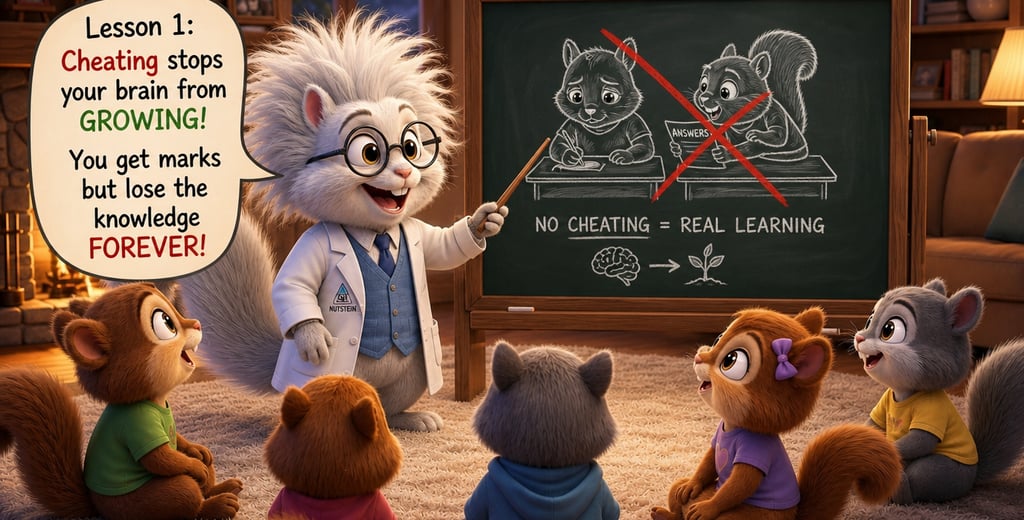
In today’s hyper-competitive, fast-paced academic environment, the temptation to take a shortcut has never been greater. Whether through traditional copying, sophisticated plagiarism, or an overreliance on generative artificial intelligence, the pressure to produce flawless results drives many students to cheat.
To a stressed student, cheating feels like a lifeline—a quick fix for earning a high grade. However this is a dangerous illusion. While dishonesty may yield short-term success, it extracts a devastating long-term cost on an individual's academic, personal, and professional development.
Educators stand on the front lines of this battle. It is no longer enough to simply enforce academic integrity policies; teachers must actively help students understand why genuine learning matters. Here are five foundational lessons educators can use to expose the folly of cheating and guide students back to authentic achievement needed for long-term success.
1. The Erasure of Knowledge: Cheating Prevents Real Learnin
Education is not a transaction in which time is exchanged for a letter grade; it is a transformative process of cognitive growth, deep understanding, and preparation for the complexities of life. When students cheat, they aren't outsmarting the system—they are denying themselves the very learning experiences meant to develop their creative minds. Educators must remind students that by bypassing the struggle of an assignment, they are denying themselves the opportunity to strengthen their critical thinking skills, problem solving abilities, and the cognitive skills essential for future success that the particular assignment was designed to build.
2. The Internal Decay: Dishonesty Weakens Character
True success is not an illusion manufactured by appearing intelligent; it is forged through diligence, responsibility, and accountability. Every time a student chooses dishonesty, they chip away at their own ethical foundation. Teachers should emphasize that classroom assignments are low-stakes environments designed to build high-stakes character. Who we are when no one is watching defines our future leadership.
3. The Fragile Ego: Cheating Damages Confidence and Independence
Relying on someone else’s work—or an AI's output—sends a damaging psychological message to oneself: “I am not capable of doing this on my own.” Over time, cheating erodes a student's self-confidence, creating a toxic dependency on outside sources. By encouraging students to value effort over perfection, teachers can help them see that an imperfect, original piece of work is infinitely more valuable than a stolen masterpiece. Originality builds independence.
4. The Broken Social Contract: Cheating Creates Unfairness
A classroom, much like society, relies on a shared social contract of fairness. When one student cheats, it skews the curve, devalues the hard work of their peers, and introduces cynicism into the learning environment. Educators can utilize classroom discussions to draw parallels to the real world: just as we expect athletes to compete without performance-enhancing drugs, we must expect students to approach academia with clean hands. Fairness in education prepares us for justice in the society.
5.The Power of the Pivot: Reframing Mistakes as Progress
The root cause of most cheating is the paralyzing fear of failure. To combat this, teachers must cultivate an environment where mistakes are not penalized as defeats, but celebrated as data points for improvement. When students internalize the idea that mistakes are a natural, necessary part of the learning curve, the desperation to cheat subsides. The students become willing to independently think, take intellectual risks, and take genuine pride in their own work.
The Ultimate Lesson
Ultimately, the greatest gift an educator can give a student is the realization that a grade is just a shadow cast by the actual object: knowledge. By dismantling the folly of cheating, teachers don't just protect the integrity of their classrooms—they hand their students the keys to an authentic, confident, and self-reliant life.